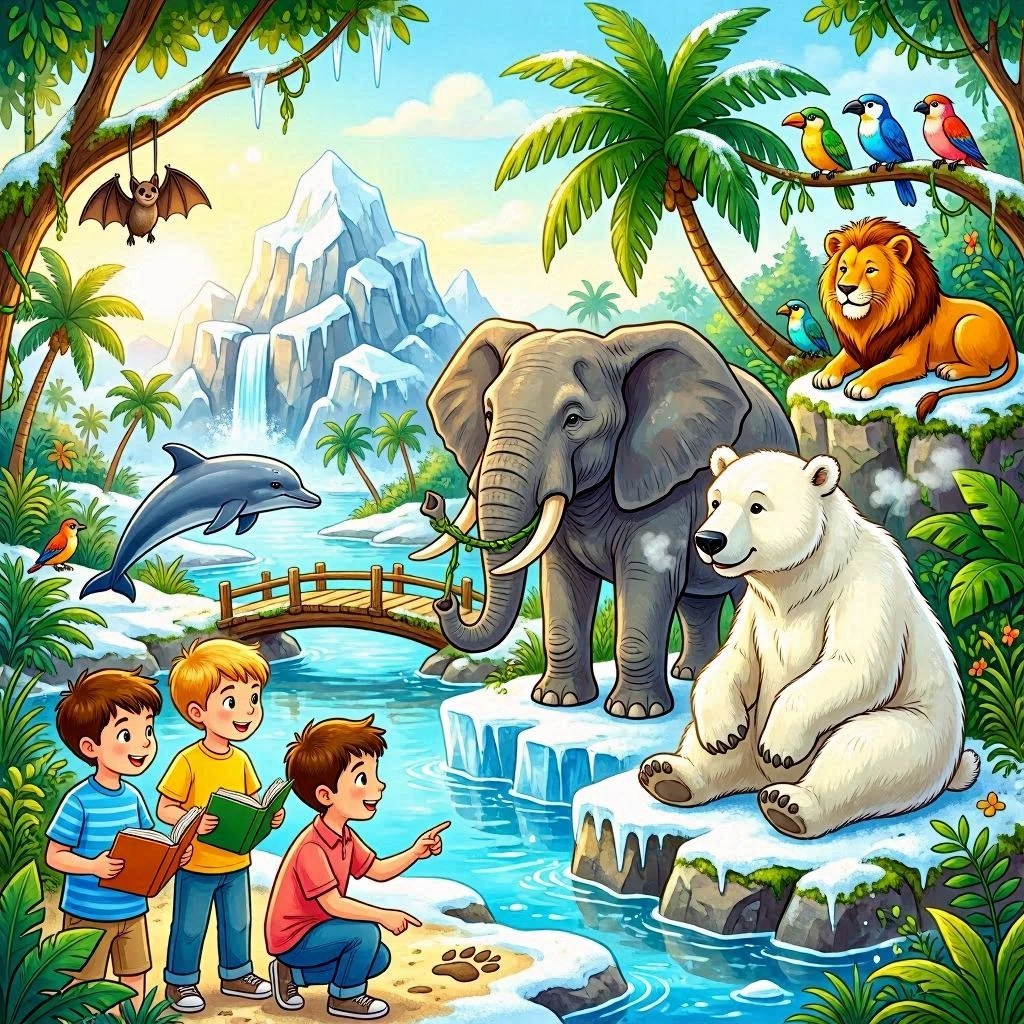
The animal kingdom is one of the most extraordinary subjects a young person can explore. With over 8 million known species on Earth — and scientists estimating millions more yet to be discovered — the diversity, adaptability, and sheer wonder of animal life is virtually unlimited. From the deepest ocean trenches to the highest mountain peaks, animals have evolved remarkable strategies for survival that continue to astonish researchers and delight curious children in equal measure.
At Bimtar, our Animal Explorer Quiz is built around exactly this sense of wonder. We believe that every fascinating animal fact is a doorway to deeper learning — in biology, ecology, geography, and even philosophy. In this article, we explore some of the most extraordinary animal kingdom facts, organised by theme, to help children (and their parents!) appreciate just how remarkable the natural world truly is.
Surprising Facts About Animal Bodies
One of the things that makes animals so endlessly fascinating is the extraordinary variety of body designs that evolution has produced. Consider the humble earthworm: this creature, which most children associate with garden soil after rain, actually has not one but five pairs of heart-like pumping organs — ten in total — that circulate blood throughout its long, segmented body. This is just one example of how the "basic" blueprint of life can be adapted in completely unexpected ways.
Perhaps even more surprising is the polar bear. Ask any young child what colour a polar bear is, and they will immediately answer "white!" — but they would only be half right. While a polar bear's fur is indeed transparent (appearing white by reflecting light), the skin underneath is completely black. This black skin acts as a solar panel, absorbing heat from the sun to keep the bear warm in Arctic temperatures that would be lethal to most other large mammals. The white fur provides camouflage against the snow, while the black skin maximises warmth absorption — an elegant example of evolutionary dual-function design.
The octopus offers yet another example of biological surprise. This creature has not one, not two, but three hearts. Two of these hearts pump blood exclusively to the gills, where it receives oxygen, while the third — the systemic heart — pumps oxygenated blood to the rest of the body. Even more remarkably, an octopus has blue blood rather than red, because it uses a copper-based molecule called haemocyanin to carry oxygen, rather than the iron-based haemoglobin found in human blood.
Record-Breaking Animals: The Fastest, Tallest, and Longest-Lived
Children are naturally drawn to superlatives — the biggest, the fastest, the most extreme. The animal kingdom delivers on every front. The Peregrine Falcon holds the title of the fastest animal on Earth, reaching speeds of over 320 kilometres per hour when diving at prey from great heights. To put this in perspective, a Peregrine Falcon's hunting dive is faster than a Formula 1 racing car at top speed.
On land, the Cheetah holds the record, reaching 100 kilometres per hour from a standstill in approximately three seconds — faster than most sports cars can accelerate. However, the Cheetah can only maintain this incredible speed for short bursts of 20 to 30 seconds before needing to rest and cool down.
The Giraffe, the tallest living land animal, can reach heights of up to 5.5 metres, with its neck alone measuring nearly 1.8 metres. Surprisingly, a giraffe's neck contains exactly the same number of vertebrae as a human neck — seven — but each individual vertebra is dramatically elongated.
When it comes to lifespan, the Greenland Shark may be the most astonishing animal of all. These slow-moving deep-water sharks have been estimated to live for over 400 years, making them the longest-lived vertebrates known to science. A Greenland Shark alive today may have been born during the era of the Ottoman Empire.
How Animals Communicate and Think
The question of animal intelligence and communication is one of the most active areas of scientific research today, and children are natural participants in this curiosity. Elephants communicate through infrasound — low-frequency rumbles that travel through both the air and the ground, allowing herds to coordinate across distances of several kilometres. They use their sensitive feet to "hear" these vibrations, supplementing what they detect through their large ears.
Dolphins have demonstrated the ability to recognise themselves in mirrors, use names for one another (through unique signature whistles), and solve complex multi-step problems. Chimpanzees have been taught to use sign language and have shown clear evidence of empathy, tool use, and basic numerical understanding. Even octopuses — despite having no vertebrate ancestry — regularly surprise researchers with their problem-solving ability, including opening jars, navigating mazes, and recognising individual human faces.
Animal Parenting and Social Structures
The variety of parenting strategies in the animal kingdom is another rich area for learning. Emperor Penguins breed in the Antarctic winter — the harshest conditions on Earth for any bird — with the male balancing a single egg on his feet and covering it with a warm flap of skin, enduring months of total darkness and temperatures below minus 40 degrees Celsius without eating. This extraordinary commitment to parenting captivates children and adults alike.
Elephant herds are led by the oldest female — the matriarch — who carries decades of accumulated knowledge about water sources, migration routes, and danger signs. When a matriarch dies, the loss of her knowledge can have devastating effects on the entire herd, demonstrating that knowledge, not just physical strength, is the most valuable resource in the animal kingdom.
Why Learning About Animals Builds Better Young Scientists
When children engage with animal facts — whether through quizzes, books, or documentaries — they are developing skills that extend far beyond biology. They are practising hypothesis testing ("I wonder if the bear with the thicker fur lives in a colder climate?"), comparative thinking ("How is this animal similar to and different from what I know?"), and evidence-based reasoning ("The book says octopuses can solve problems — but what kind of problems?"). These are the foundational intellectual skills of science, philosophy, and critical thinking.
Bimtar's Animal Explorer Quiz is designed to be the beginning of a learning journey, not the end of one. Each question and explanation is a prompt to wonder further, to search for more information, and to ask the follow-up questions that good science always produces. We encourage parents to use the quiz as a conversation starter — exploring the explanations together, looking up follow-up facts, and perhaps even visiting a local wildlife centre or nature reserve to experience the animal kingdom firsthand.
Conclusion: A World of Wonder Awaits
The animal kingdom is not just a topic for school — it is one of the great endless adventures of human curiosity. Every species is a unique solution to the challenges of survival, reproduction, and living alongside others. For children who develop genuine interest in animals early in life, a lifetime of discovery awaits — in nature documentaries, zoos, scientific journals, and the natural world right outside their door. Start that journey today with Bimtar's Animal Explorer Quiz and see how many amazing facts your young explorer can discover.
Test your animal knowledge!