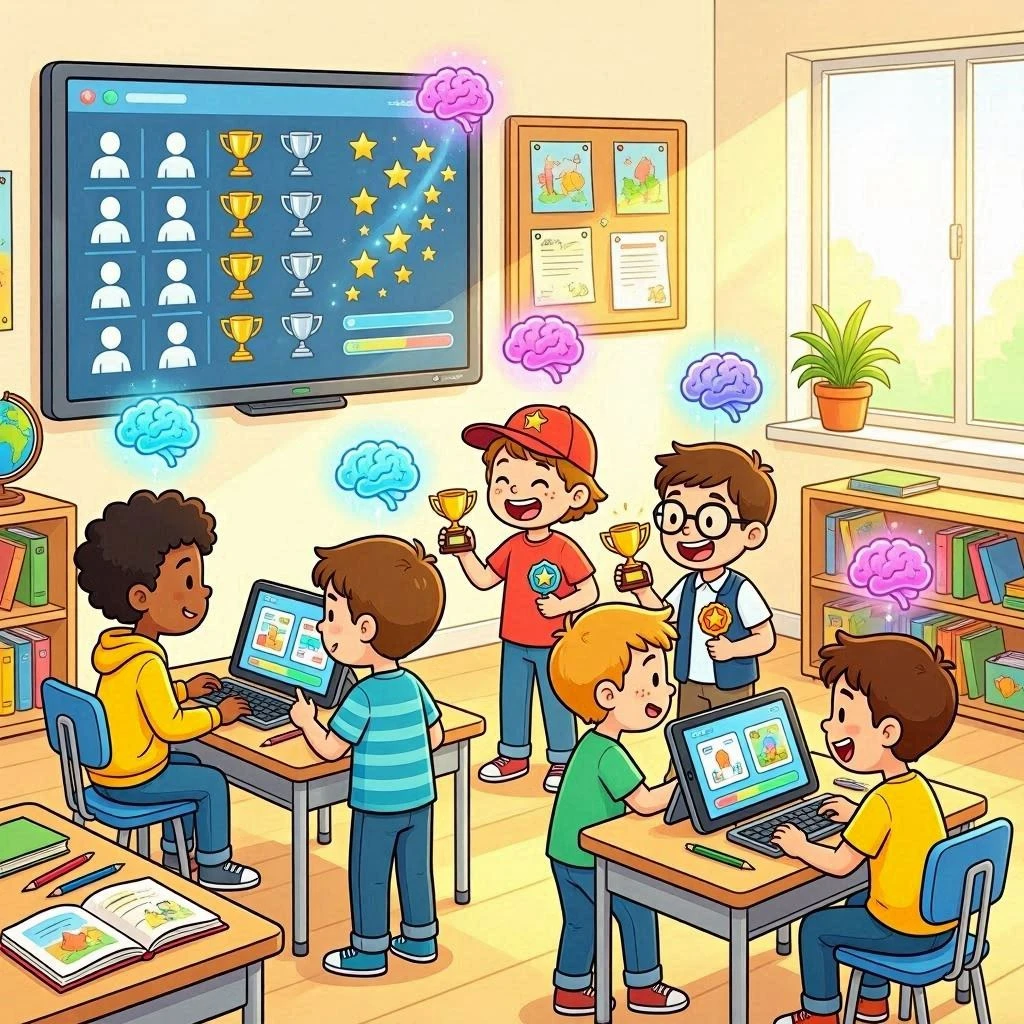
Gamified learning — the application of game design principles to educational content — has moved from buzzword to evidence-backed pedagogy. Children learn more, retain more, and enjoy education more when it feels like play. The answer lies deep within the architecture of the developing human brain.
The Dopamine Connection
When a child selects an answer and waits to see if it is correct, their dopamine system enters a state of heightened anticipation. When the correct answer is confirmed with positive feedback, dopamine is released. This release strengthens neural pathways in the hippocampus, the brain's memory centre. Even an incorrect answer triggers curiosity resolution — finding out why the other option was correct produces a mild dopamine response that encodes the correct information more deeply.
The Forgetting Curve and Retrieval Practice
Hermann Ebbinghaus showed that without reinforcement, people forget approximately 50% of new information within an hour. The solution: spaced retrieval practice. Every time we are challenged to recall information, the forgetting curve is reset. A landmark 2006 study by Roediger and Karpicke found that students who studied and then took a practice test retained 50% more information after one week than those who studied twice. Quizzes are, by their very nature, retrieval practice.
Game Elements That Amplify Learning
Progress Bars and Visible Advancement
Seeing a progress bar advance provides a tangible sense of forward momentum. Research in motivational psychology confirms that visible progress is one of the strongest drivers of sustained engagement in any learning task.
Immediate Corrective Feedback
Feedback that arrives while the learning experience is still emotionally "hot" maximises its impact on memory formation. Bimtar provides explanations immediately after every answer, making each question a mini lesson.
Celebration of Mastery
The "Well Done! 🎉" moment at the end of a quiz activates the brain's achievement-processing system. Carol Dweck's research on growth mindset demonstrates that celebrating completion and effort — rather than raw scores — builds the resilience and persistence that characterise lifelong learners.
Optimal Challenge Level
Psychologist Mihaly Csikszentmihalyi identified "flow" — deep engagement when a task is neither too easy nor too hard. Effective quizzes walk this line carefully, stretching learners without overwhelming them.
Age-Specific Benefits for Primary Children
- 🌟 High intrinsic curiosity — Children naturally want to know the "why" behind everything.
- 🌟 Strong episodic memory formation — Emotionally rich experiences are stored with extraordinary detail.
- 🌟 Identity formation — Positive learning experiences shape a lifelong learner identity.
- 🌟 Responsive to narrative — Framing learning as a "mission" dramatically increases engagement.
The Social Dimension
Even without multiplayer features, quizzes create a social narrative. Children share scores with parents and siblings. A study in the British Journal of Educational Technology found that children who discussed quiz results with parents showed significantly higher learning gains than those who played in isolation. The simple act of asking "What did you learn today?" multiplies the value of every session.
Guidance for Parents
- 🔬 Use quizzes after initial learning — Read about animals, then try the Animal Explorer Quiz.
- 🔬 Space the practice — Three 10-minute sessions across a week outperform one 30-minute session.
- 🔬 Review wrong answers together — These are the highest-value learning moments.
- 🔬 Let children teach you — Teaching consolidates understanding more powerfully than any other activity.
- 🔬 Vary the topics — Mixing math and animal quizzes creates "interleaved practice," improving retention by up to 40%.
Conclusion: Play Is Learning
The science is unambiguous: gamified quizzes align educational delivery with the genuine architecture of the developing brain. They are not a replacement for thoughtful teaching — they are a powerful complement that meets children in the state where they are most receptive: playful, curious, and eager to discover what comes next. 🌟
Experience it for yourself!