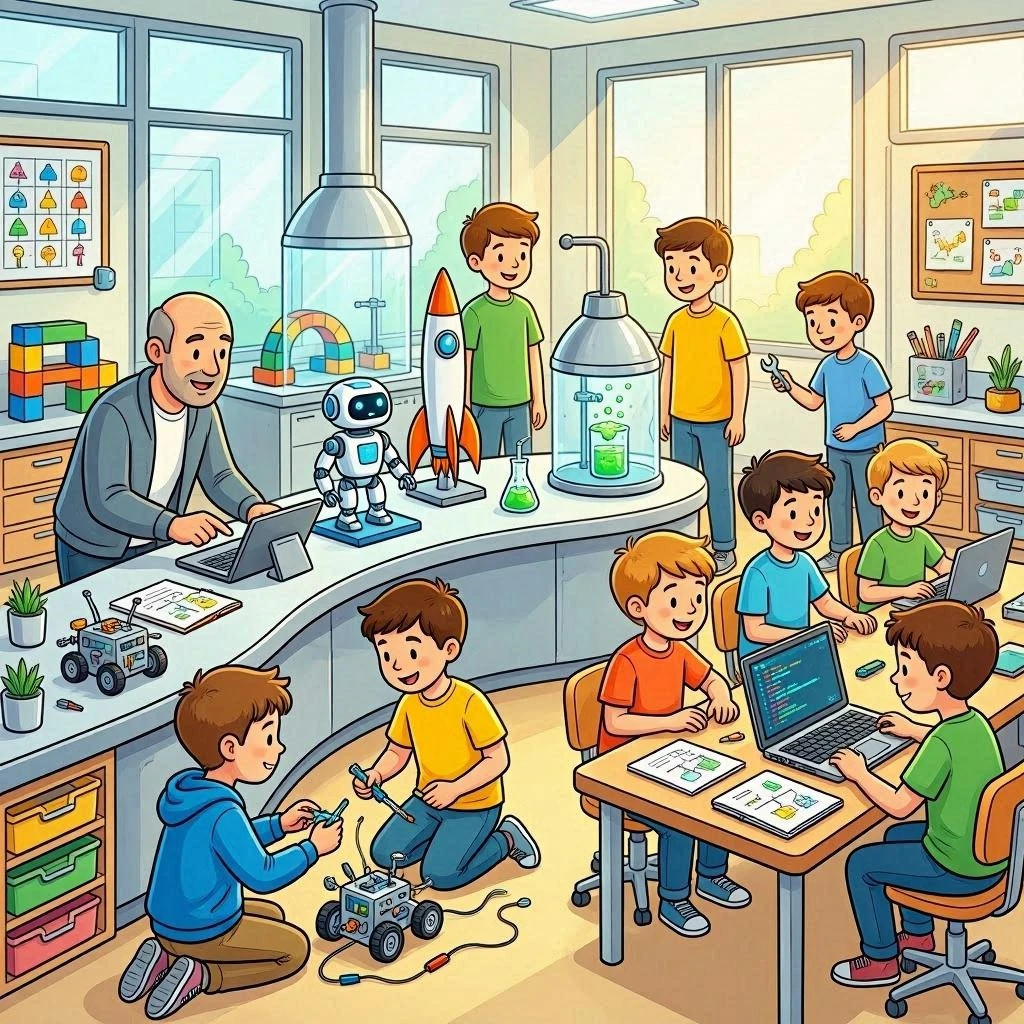
Science, Technology, Engineering, and Mathematics — collectively known as STEM — are not simply academic subjects. They are the foundational languages of the modern world. From the smartphones in our pockets to the algorithms that power the internet, from the medical devices that save lives to the sustainable technologies that will shape our planet's future, every aspect of contemporary life is built on STEM principles. For parents and educators who care about preparing children for the world ahead, nurturing STEM curiosity early is not optional — it is essential.
Yet STEM education is often misunderstood. Many parents assume it requires expensive laboratory equipment, advanced textbooks, or specialised tutors. In reality, the most effective STEM education for young children begins with something far simpler: curiosity, questions, and the freedom to explore. This article explores what STEM education truly means for children aged 5 to 12, why it matters so deeply, and how parents can nurture it naturally at home.
What STEM Education Really Means for Young Children
For primary school children, STEM education is not about producing miniature engineers or future data scientists. It is about cultivating a set of thinking skills and attitudes that will serve them in every area of life. These include logical reasoning — the ability to follow a chain of cause-and-effect thinking to reach a conclusion. They include systematic problem-solving — the habit of breaking large, complex problems into smaller, manageable steps. They include evidence-based thinking — the discipline of forming beliefs based on data and observation rather than assumption or habit.
They also include one of the most valuable and most frequently overlooked skills in any child's development: comfort with being wrong. Science advances through failed experiments. Engineering improves through broken prototypes. Mathematics reveals itself through incorrect calculations that point toward better methods. Children who learn early that mistakes are data — not failures — develop a resilience and intellectual courage that allows them to tackle difficult problems throughout their lives.
The Economic Reality: Why STEM Skills Matter for Future Careers
The career landscape your child will enter looks dramatically different from the one their parents navigated. The World Economic Forum's Future of Jobs Report consistently identifies STEM-related skills — data analysis, logical reasoning, programming, scientific thinking — as among the most in-demand capabilities across virtually every industry sector. This is not because every future career will be in a laboratory or tech company. It is because every future career will require the ability to work with data, to think systematically, and to adapt quickly to new technologies.
A 2023 analysis by the Bureau of Labor Statistics (USA) found that STEM occupations are projected to grow at approximately twice the rate of non-STEM occupations over the coming decade, with median annual wages consistently higher across STEM fields. In the United Kingdom, the Royal Academy of Engineering estimates that the country needs approximately 186,000 additional STEM professionals per year to meet demand. Similar trends are observed across Europe, Asia, and the broader developing world.
For parents raising children today, these are not abstract statistics — they represent the world their children will inherit. Building STEM foundations early is not simply an academic choice; it is a profound act of care for your child's future.
The Science of How Children Learn STEM Concepts
Young children are natural scientists. Watch any toddler interacting with water, sand, or soil, and you will see the scientific method in action: hypothesis (I wonder what happens if I pour this here?), experiment (pour), observation (water goes there!), and modified hypothesis (what if I pour it faster?). This instinctive curiosity-driven exploration is the purest form of scientific thinking, and it is present in every child long before formal schooling begins.
The challenge — and the tragedy, in many cases — is that traditional educational systems often teach children to suppress this natural curiosity in favour of memorising correct answers and avoiding incorrect ones. By the time children reach secondary school, many who were naturally curious scientists at age 5 have been conditioned to fear making mistakes, to prioritise "getting the right answer" over exploring the question, and to see STEM subjects as inherently difficult rather than inherently fascinating.
Research from the University of Colorado's Science Education Initiative shows that children who engage in active, inquiry-based science activities — exploring questions through hands-on experimentation and interactive games — retain STEM concepts at rates 3 to 5 times higher than children taught through passive instruction alone. Interactive educational tools, including well-designed quiz platforms like Bimtar, are valuable precisely because they engage children as active participants rather than passive recipients.
Mathematics as the Language of STEM
Among the four STEM disciplines, mathematics occupies a uniquely foundational role. Every field of science requires mathematical literacy — from calculating drug dosages in medicine to modelling climate systems in environmental science, from designing load-bearing structures in engineering to optimising algorithms in computer science. A child who develops genuine mathematical confidence and fluency in their primary school years has opened doors to every STEM pathway available.
This is why Bimtar's Math Wizard Quiz is not just a fun activity — it is a STEM investment. Every session of arithmetic practice builds the automatic number sense that future mathematicians, scientists, and engineers will rely on throughout their careers. The randomised nature of Bimtar's questions ensures that children build broad, flexible numerical thinking rather than rote familiarity with a fixed set of problems.
Practical Ways to Build STEM Curiosity at Home
- Encourage "why" questions and take them seriously — When your child asks why the sky is blue or why bread rises, treat the question as the valuable intellectual inquiry it is. Look up the answer together.
- Build with everyday materials — Cardboard boxes, tape, straws, and rubber bands can become engineering challenges. "Can you build a bridge strong enough to hold ten coins?" is both engineering and mathematics.
- Cook together with measurement — Baking is applied chemistry and mathematics. Measuring ingredients, timing, and observing reactions all build STEM intuition.
- Use educational apps and quiz tools strategically — Interactive platforms like Bimtar build numerical fluency and scientific thinking in formats children find genuinely enjoyable.
- Visit science museums, zoos, and nature reserves — Direct experience with science in action is irreplaceable. A visit to a natural history museum can ignite a lifelong passion.
- Watch science documentaries together — Programmes narrated by Sir David Attenborough, Neil deGrasse Tyson, and others bring STEM to life with remarkable visual storytelling.
- Celebrate curiosity as a value — Praise your child not just for correct answers, but for asking interesting questions, noticing unexpected things, and persisting through confusion.
Addressing the Gender Gap in STEM
One of the most important conversations in STEM education today concerns gender. Research consistently shows that girls and boys enter primary school with equal levels of mathematical and scientific ability, yet by secondary school significant gaps in confidence and participation have emerged. These gaps are not biological — they are the product of cultural messaging, implicit teacher bias, and a lack of visible role models.
Parents and educators play a critical role in counteracting these patterns. Actively encouraging girls' curiosity in science and mathematics, providing access to female role models in STEM fields, and avoiding gendered language around academic subjects ("boys are just better at maths") are all evidence-based strategies for maintaining girls' STEM engagement through the critical middle school years.
Platforms like Bimtar are designed to be entirely gender-neutral — every child who uses them is treated as a capable, curious learner, regardless of background or gender. This inclusive approach to learning is one of the most important features of any effective educational tool.
Conclusion: The Most Important Investment You Can Make
In a world of rapid technological change and complex global challenges, the children who will thrive are those who know how to think — how to ask good questions, test their assumptions, learn from failure, and adapt to new information. STEM education, at its best, teaches exactly these skills. It is not about producing scientists and engineers — it is about producing thoughtful, capable, resilient human beings who can engage with whatever challenges their world presents. Begin that investment today, one curious question at a time.
Build STEM foundations through play!